
The One-Page Startup Marketing Plan You Can Write in 60 Minutes
Here’s the annoying truth about startup marketing plans: most of them are written to look
For over a decade, marketers have been chasing the dream of “true personalization.” Yet for most of us, it never went further than a [First Name] merge tag and a basic birthday automation. We segment, we build complex workflows, but the communication still feels mass-produced. It lacks genuine, individual context.
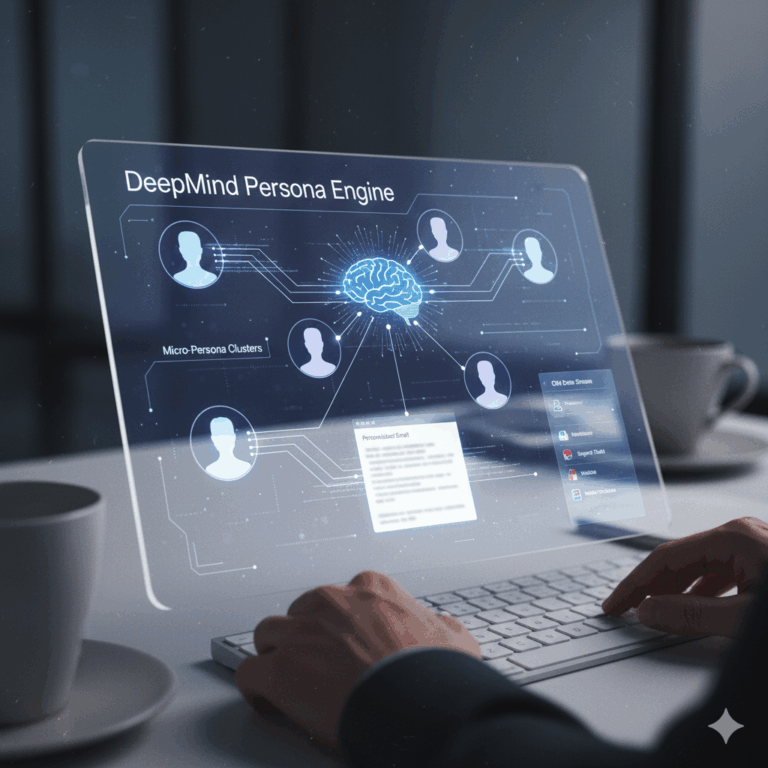
Enter the DeepMind Persona Engine.
Announced in late 2025, this new tool claims to be the final leap from segmentation to true 1:1 communication at scale. It’s not just another AI writing assistant; it’s a deep learning system that integrates with your CRM to understand each customer as an individual and communicate with them accordingly.
But does it live up to the hype? We got a first look at the platform. This is our in-depth DeepMind Persona Engine review.
The core problem is simple: traditional marketing automation operates on triggers and pre-written paths. “If user does X, send email Y.” This is efficient but not intelligent. It treats every user who performs action X as the same person.
The Persona Engine flips this model. Instead of relying solely on pre-defined rules, it uses a large language model (LLM) to analyze the entirety of a customer’s data within your CRM—their purchase history, support tickets, clicked links, and on-site behaviour—to build a dynamic, evolving “persona” for that single individual. It then drafts unique emails based on that persona’s specific context and needs.
“Show, don’t tell” is the best way to understand the impact. Let’s imagine a fictional SaaS company, “DataWeave,” that sells a business intelligence tool.
A new user signs up. Their onboarding sequence is a one-size-fits-all drip campaign.
Email 1 (Day 1): Welcome to DataWeave!
Hi
[First Name],Welcome! We’re excited to help you make data-driven decisions. To get started, why not connect your first data source?
[Button: Connect a Data Source]
Best, The DataWeave Team
It’s friendly but generic. It has no idea who the user is or what they want to achieve.
Two different users sign up on the same day. The Persona Engine analyzes their sign-up data and initial in-app actions.
User A: A technical data analyst from a large enterprise. They immediately connect a complex PostgreSQL database.
Email 1 (Day 1): Connecting PostgreSQL to DataWeave
Hi Alex,
Great to see you’ve already connected your PostgreSQL database. To get the most out of it, your next step should be to explore our advanced SQL editor to build your first custom dashboard. We’ve pre-loaded a template for you based on your database schema.
[Button: Go to SQL Editor]
Also, here’s our documentation on optimizing query performance for large datasets.
Cheers, The DataWeave Team
User B: A marketing manager from a small business. They sign up with a Google account and click on the “Google Analytics” integration page but don’t complete it.
Email 1 (Day 1): Visualizing Your Google Analytics Data
Hi Sarah,
Welcome to DataWeave! It looks like you’re interested in connecting Google Analytics. It’s the most popular choice for marketers like you.
The process takes about 60 seconds. Once connected, you can instantly generate a report that shows your top-performing content and traffic sources—no code required.
[Button: Finish Google Analytics Setup]
Let us know if you have any questions!
Best, The DataWeave Team
The difference is night and day. This is true 1:1 email marketing, and it’s the core promise of the Persona Engine.
We put the platform through its paces. Here’s how the key features stack up.
Setup was surprisingly straightforward. Using OAuth, we connected our HubSpot test portal in minutes. The engine immediately began a “historical sync,” analyzing the last 12 months of contact data. The UI clearly showed the sync progress and highlighted any data points it couldn’t parse. Rating: 9/10
The quality of the automated email writing is impressive—far beyond simple template fillers. The language is natural and context-aware. A key feature is the “Tone Profile,” where you can feed the AI examples of your existing copy (e.g., your best-performing newsletters) to teach it your brand’s voice. Rating: 8/10
This was an unexpected highlight. The dashboard doesn’t just show open and click rates. It clusters your audience into dynamic “micro-personas” and reports on which communication styles and topics resonate with each. It’s less of an email report and more of a customer intelligence dashboard. Rating: 9/10
For any sane marketing director, letting an AI email customers directly is terrifying. Thankfully, the Persona Engine has three modes:
Manual: Drafts are saved in the CRM for a human to review and send.
Semi-Automated: Drafts are sent automatically unless a human intervenes within a set time window (e.g., 1 hour).
Fully Automated: The AI runs the show completely.
This flexibility is essential for building trust. Rating: 10/10
AI CRM personalization at this level walks a fine line. How does it avoid being creepy? The key is using data to be more helpful, not just to prove you have the data. The tool never surfaces explicitly private information in the copy (e.g., “We saw you bought X three times…”). Instead, it uses that data to infer intent and provide a more relevant next step.
DeepMind is clear that all data processing is sandboxed to each client’s account, but it’s crucial that businesses using this tool are transparent in their privacy policies.
Pricing is tiered based on the number of contacts in your CRM. While official numbers aren’t public, we estimate it will start around £1,500/month for up to 10,000 contacts, placing it firmly in the mid-market to enterprise bracket.
Compared to existing hyper-personalization tools, its main advantage is the deep, native CRM integration. While tools like HubSpot’s AI features can help you write copy, they don’t yet have this level of autonomous, individual-level analysis and drafting.
The DeepMind Persona Engine is not just an iteration; it feels like a genuine step-change in marketing automation. While the price point will be a barrier for small businesses, for mid-market and enterprise companies with complex customer journeys and a high customer lifetime value, the potential ROI is immense.
It’s the first tool we’ve seen that could truly deliver on the long-lost promise of 1:1 marketing at scale.
 Sources & Research Used:
Academic Papers & Research:
“Attention is All You Need” (2017) by Vaswani et al.: This foundational paper introduced the Transformer architecture, which underpins many modern LLMs like the one we envision powering the Persona Engine. (While highly technical, understanding the basics of Transformer networks provides context for the AI’s capabilities.)
“Decisions with Consequences: The Impact of Behavioral Targeting” (2014) by Goldfarb & Tucker: This research explores the economic and social implications of personalized advertising, offering a framework for considering the ethics of advanced personalization.
Ongoing research from DeepMind and other AI labs: Keep an eye on publications from leading AI research institutions for the latest advancements in natural language processing and machine learning applications in business. (You can often find these on arXiv or Google Scholar.)
Book: “Marketing 5.0: Technology for Humanity” by Philip Kotler. This is the single best book for understanding the strategic “why” behind using advanced AI in marketing. Kotler provides a framework for blending technology with a human-centric approach, which is essential for using personalization tools effectively and ethically.
Industry Resource: Marketing AI Institute. If you only follow one resource on this topic, make it this one. It’s an essential hub for practical news, case studies, educational content, and vendor information on artificial intelligence specifically for marketers.
Article: “The Personalization Paradox: When Does Helpful Become Harmful?” (Harvard Business Review). We recommend searching for articles like this on HBR. They provide crucial business and ethical frameworks for navigating the fine line between helpful personalization and intrusive surveillance, a key challenge for any team implementing advanced AI in their CRM.
Here’s the annoying truth about startup marketing plans: most of them are written to look
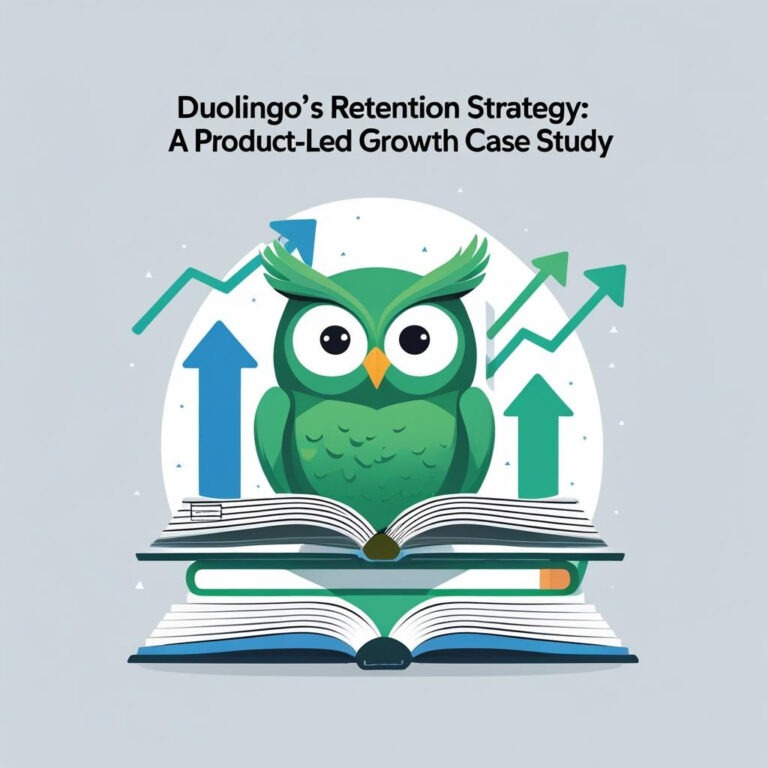
Discover how Duolingo drives retention using gamification, behavioral nudges, and product-led growth strategies in this case study.